Aside: This article was adapted from the results of my undergraduate research.
Introduction
Fast radio bursts are mysterious radio pulses coming from outside our Milky Way galaxy, they are powerful enough to emit the equivalent power of three days of our Sun’s output in mere milliseconds.
The origins of fast radio bursts are unknown to us, they could be anything from black holes, neutron stars, even extraterrestrial life. This mystery remains unsolved today, and is even listed in wikipedia’s list of unsolved problems in astronomy (as of Nov. 2023).
But what are they really? why should we care? and what do we know now?
Fast Radio Bursts (FRB)
Fast radio bursts are transient radio pulses that typically last from microseconds to milliseconds. Most FRBs are extragalactic, coming from outside the Milky Way, with one known exception [1]. But why care so much about FRBs?
FRBs can be used as probes of the universe, allowing us to map the distribution of electrons and magnetic fields of anything it passes through like a flashlight. Since they can come from outside our galaxy, this essentially allows us to map out the universe outside our galaxy!
This extragalactic origin enables scientists to explore a hidden universe, which remains beyond the reach of even our most powerful telescopes [2]. Research exists today using FRBs as comic flashlights, shedding light on the ongoing processes of galaxy formation [3].
When an FRB passes through intergalactic regions with varying electron densities, the signal is refracted by the electrons before reaching Earth. This means that the intensity and arrival times of the signal vary when it is detected. These fluctuations in signal intensity and arrival times are called ‘scintillation’, and are important in the context of understanding FRB properties.
Dispersion Measure (DM)
As radio signals travel from the source to the earth, they are refracted by the intergalactic medium, or IGM, similar to Newton’s famous experiment where he dispersed white light to its constituent parts using a prism.
The refractive index, the ratio between the speed of light in a vacuum to the speed of light in a certain material, of the IGM is inversely proportional to the frequency of the signal, so higher radio frequencies arrive before lower ones.
This delay is proportional to the number of electrons along the line of sight between the observer (on Earth) and the FRB source; this delay is quantified as the dispersion measure, or DM (in ). Note that since the longer the line of sight, the higher the DM, it can be used as a proxy for distance.
DM can be inferred by the arrival time delay of two different radio frequencies and , one higher than the other, calculated using the equation below [4]:
There are two types of DM,
- Structure maximizing DM
- Signal-to-noise maximizing DM
Let’s take a look at what happens when we de-disperse the same burst for these two DM types.
Structure Maximizing DM
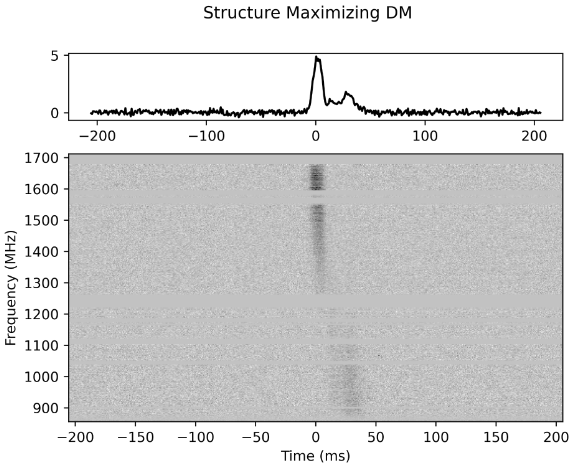
Structure maximizing (SM) DM is a de-dispersion that maximizes the features of the pulse, like drifting, sub-pulses, etc. The time series above (Fig. 1) shows a small sub-burst, invisible here on the time series of the other DM type.
Signal-to-noise (S/N) Maximizing DM
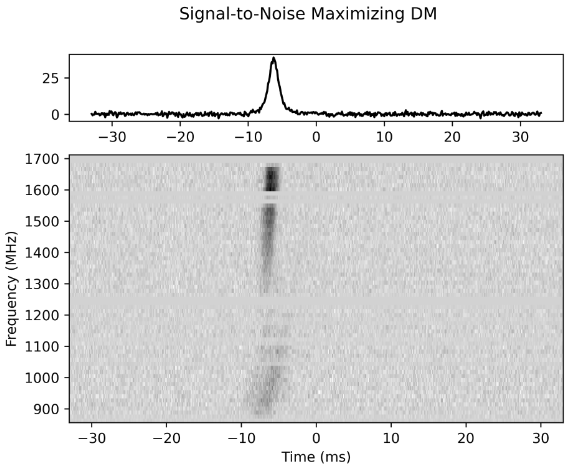
Signal-to-noise (S/N) maximizing DM is a de-dispersion that maximizes the signal strength by lining up the signal to form a peak. This is useful to examine the burst’s time parameters like its arrival time for example, especially for weaker pulses. You can see that this burst is much more intense when examining the dark spots of the waterfall plot (Fig. 2).
The Lorimer Burst - The First FRB
Fig 3. is the waterfall plot for the first FRB signal discovered - called the ‘Lorimer burst’ [4]. It refers to the dispersion sweep expected for propagation through the IGM.
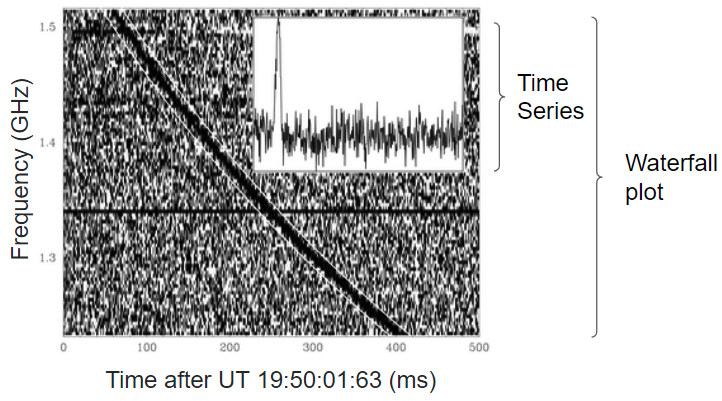
The range of frequencies on the graph represents the bandwidth of the radio telescope (which here is the Parkes Observatory). The burst signal itself is this black line sweeping down and to the right. As you can see, just like in the prism dispersion experiment, the higher frequencies are dispersed less and arrive earlier to be detected first.
The smaller plot in the top right shows the de-dispersed signal - this is where the signal detected is corrected for the time delay we’ve been talking about (by shifting the frequencies so their arrival times are equal), and averaging over the different frequencies to get a peak in time - the peak we see in this plot.
The calculated DM of the Lorimer burst was found to be much higher than the DM expected for an object within the Milky Way - suggesting that this mysterious signal was extragalactic. The expected DM of the Milky Way is around , but the DM observed for the Lorimer burst was around .
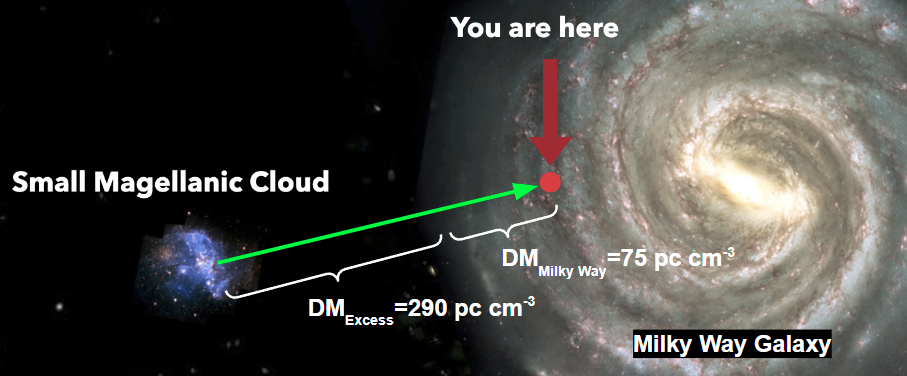
The burst is thought to have originated near the Small Magellanic Cloud.
A Brief History of Fast Radio Bursts
Here is a brief historical timeline of events to keep you up to date.
- In 2007, Duncan Lorimer and his colleagues discovered the first FRB named the “Lorimer Burst” while searching through Parkes Observatory data from 2001.
- In 2011, The second FRB, FRB010621, was observed in the Parkes Multibeam Pulsar Survey.
At this point in time, FRBs were still regarded as a controversial topic in radio astronomy since they were all detected in Parkes. FRB detections may have just been the result of faulty equipment at Parkes.
- These doubts were laid to rest In 2014, when FRB121102 was discovered in another observatory, the Arecibo Observatory in Puerto Rico.
- In 2016, Arecibo found that this same FRB repeated.
This was the first discovery of a repeating FRB, which ruled out cataclysmic models for FRB creation.
References
- The CHIME/FRB Collaboration. A bright millisecond-duration radio burst from a Galactic magnetar.
- G. Elizabeth, Astrophysicists turn fast radio bursts into cosmic probes.
- L. Robert, Probing Galactic Halo Gas with Fast Radio Bursts.
- Lorimer, D. R. and Kramer, M., Handbook of Pulsar Astronomy, vol. 4. 2004.
- D. R. Lorimer, et al., A bright millisecond radio burst of extragalactic origin, 2007.